
Interactive Packaging Market 2025 Sees Surge in AR, NFC, and Smart Sensors Across FMCG & Pharma
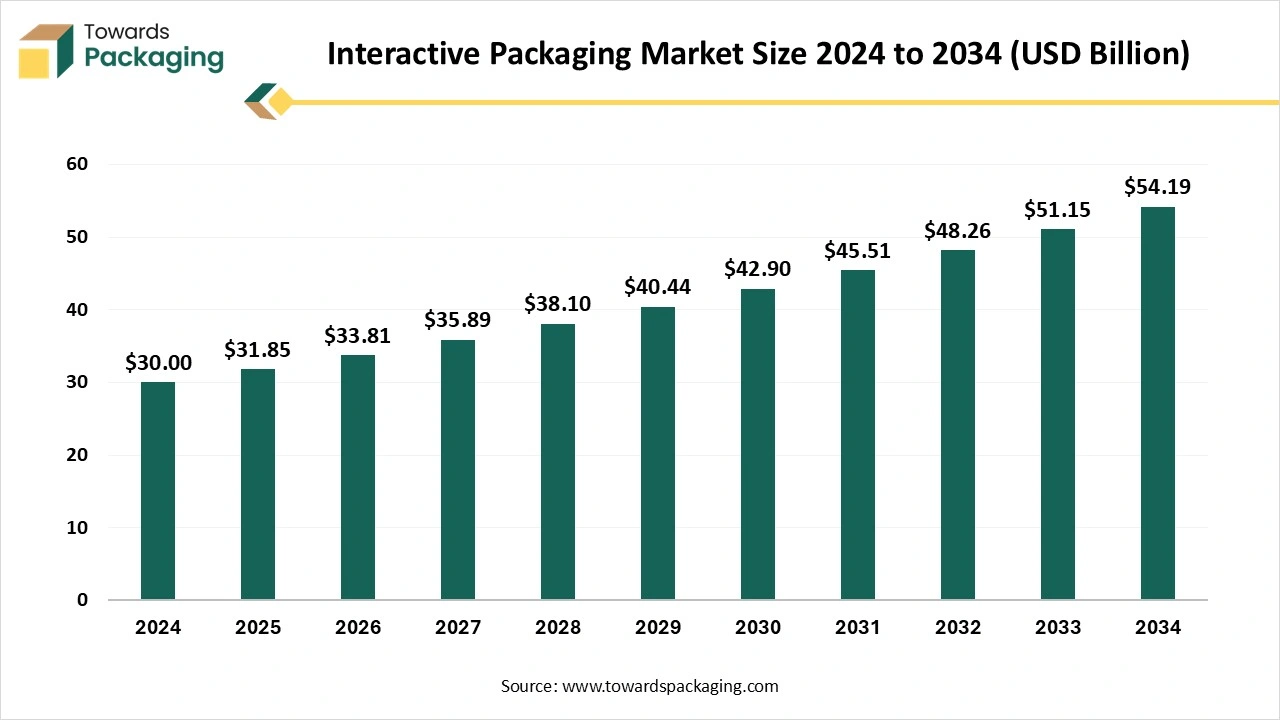
According to Towards Packaging consultants, the global interactive packaging market is projected to reach approximately USD 54.19 billion by 2034, increasing from USD 30.00 billion in 2024, at a CAGR of 6.15% during the forecast period 2025 to 2034.
Ottawa, July 17, 2025 (GLOBE NEWSWIRE) -- The global interactive packaging market size stood at USD 31.85 billion in 2025 and is projected to reach USD 54.19 billion by 2034, according to a study published by Towards Packaging, a sister firm of Precedence Research.
Get All the Details in Our Solutions – Access Report Sample: https://www.towardspackaging.com/download-sample/5527
The interactive packaging market is rapidly evolving, driven by advancements in digital technologies, growing consumer engagement demands, and the rising need for product differentiation. Brands are increasingly adopting features such as QR codes, augmented reality (AR), near-field communication (NFC), and smart sensors to create immersive and informative packaging experiences.
These technologies not only enhance brand storytelling but also provide real-time product information, authenticity verification, and personalized marketing. The growth of e-commerce, coupled with consumer preferences for transparency and interactivity, is further propelling the market. Additionally, sustainability and traceability trends are encouraging brands to integrate interactive elements into eco-friendly packaging solutions.
What is Interactive Packaging?
Interactive packaging refers to packaging that incorporates technology or design features to engage consumers in a dynamic and personalized way. Unlike traditional packaging, which serves only to protect and display a product, interactive packaging encourages direct consumer interaction. This is often achieved through digital technologies such as QR codes, augmented reality (AR), near-field communication (NFC), and smart sensors.
These elements enable consumers to access additional information, promotional content, personalized experiences, or entertainment using their smartphones or other devices. In some cases, physical elements like thermochromic inks that change color with temperature also add interactivity. The main goal of interactive packaging is to enhance the user experience, build stronger brand connections, promote transparency, and distinguish products in competitive retail environments.
Explore Strategic Figures & Forecasts – Access the Databook Now: https://www.towardspackaging.com/download-databook/5527
What Are New Major Trends in The Interactive Packaging Market for 2025?
-
Smart & connected packaging
Packaging embedded with QR codes, NFC chips, AR experiences, blockchain traceability, and IoT sensors for freshness, authenticity, and supply‑chain transparency.
-
AI & automation
Brands are leveraging AI for design optimization, prototyping, personalized packaging, logistics efficiency, and real-time quality control. AI integration is significantly transforming the interactive packaging market by enhancing personalization, efficiency, and consumer engagement. Through machine learning and data analytics, AI enables brands to deliver personalized content via packaging, such as dynamic QR codes or NFC tags that adapt based on customer preferences or location.
-
Experiential & tactile design
Innovative shapes, textures, thermochromic inks, foldable toys, keepsake containers, and sensory finishes enrich unboxing experiences and social shareability.
-
Personalised & gamified packaging
Variable‑data printing, unit‑level QR codes, interactive games or puzzles, custom artwork, and loyalty integration are growing rapidly.
-
Sustainability & circularity
Mushroom‑ or bio‑based materials, edible coatings, plantable tags, returnable/reusable formats, and biodegradable interactive surfaces are gaining prominence.
-
Active & intelligent food packaging
Battery‑free sensors, smart films, gas scavengers, freshness indicators, microlasers, and recyclable electronics enable real‑time monitoring and spoilage prevention.
-
Chaos packaging & bold visuals
Disruptive formats that mimic unrelated products to generate buzz like tampons in ice‑cream tubs are used to grab attention on shelves and social media.
What is the Potential Growth Rate of the Interactive Packaging Market?
Rising Demand for Personalization & Smart Healthcare Packaging
Consumers seek tailored experiences, creating opportunities for brands to use interactive packaging with variable data printing, personalized messages, and dynamic QR/NFC content. Interactive features such as AR games, loyalty programs, and digital coupons foster deeper brand-consumer relationships and repeat purchases. Brands can use blockchain, digital watermarks, and NFC to verify authenticity, especially in pharmaceuticals, cosmetics, and luxury goods. Opportunities exist for dosage tracking, expiry alerts, and real-time health monitoring through intelligent packaging in the healthcare sector.
- For instance, in June 2025, Honeywell declared that its Evercare pharmaceutical brand will use Aclar film, which was chosen by Evertis, a top manufacturer of packaging film. As the industry works to transition to recyclable solutions, Evertis' assortment of Aclar films will help guarantee that patients everywhere get the life-saving drugs they require in safe packaging.
- Furthermore, in December 2024, at Pharmapack Europe 2025, which will be held in Paris, France on January 22–23, 2025, LOG Pharma Primary Packaging, a top worldwide supplier of cutting-edge packaging solutions for the pharmaceutical industry, will present its innovative barrier eco line for innovative and generic drug companies. The new eco line packaging solution provides the best moisture and oxygen protection for medications while drastically lowering the cost of producing environmentally friendly barrier bottles.
If there is anything you'd like to ask, feel free to get in touch with us @ sales@towardspackaging.com
Limitations & Challenges in Interactive Packaging Market:
Limited consumer awareness & Complex supply chains
The key players operating in the market are facing restriction Implementing smart features like NFC chips, AR, or sensors significantly increases production costs, making it less viable for low-margin or mass-market products. Many consumers are still unfamiliar with how to use interactive features, reducing the effectiveness and value of such packaging investments. Incorporating advanced technology into packaging can complicate manufacturing and logistics, especially in global supply chains. Interactive packaging often involves data collection, raising privacy and regulatory compliance issues that deter widespread adoption.
Certain smart elements, like sensors or printed electronics, may degrade over time or in harsh conditions, limiting long-term functionality. Absence of industry-wide standards for interactive components hinders interoperability, scalability, and cost efficiency across different platforms and regions.
More Insights of Towards Packaging:
- Biopolymer Packaging Market - The global biopolymer packaging market is forecasted to expand from USD 26.74 billion in 2025 to USD 70.83 billion by 2034, growing at a CAGR of 11.43% from 2025 to 2034.
- Non-Recyclable Polystyrene Packaging Market - The non-recyclable polystyrene packaging market is accelerating, with forecasts predicting hundreds of millions in revenue growth between 2025 and 2034.
- Paper-Based Sustainable Packaging Market - The paper-based sustainable packaging market is booming, poised for a revenue surge into the hundreds of millions from 2025 to 2034.
- Blockchain Technology in Packaging Market - The blockchain technology in the packaging market is forecast to grow from USD 241.26 billion in 2025 to USD 556.79 billion by 2034, driven by a CAGR of 9.84% .
- IoT-Enabled Packaging Market - The global IoT-enabled packaging market is anticipated to grow from USD 20.26 billion in 2025 to USD 29.95 billion by 2034.
- Sustainable Films for Packaging Market - The global sustainable films for packaging market is projected to reach USD 392.7 billion by 2034, expanding from USD 191.04 billion in 2025.
- Reusable E-Commerce Packaging Market - The global reusable e-commerce packaging market is forecast to grow at a CAGR of 9.54%, from USD 9.41 billion in 2025 to USD 21.12 billion by 2034.
- Microwave-Ready Packaging Market - The microwave-ready packaging market is accelerating, with forecasts predicting hundreds of millions in revenue growth between 2025 and 2034.
- PVC Packaging Film Market - The polyvinyl chloride packaging film market is projected to reach USD 17.48 billion by 2034, growing from USD 14.06 billion in 2025, at a CAGR of 2.43%.
- Contact Sensitive Packaging Market - A revenue surge in the contact sensitive packaging market is on the horizon, with growth expected to reach hundreds of millions by 2034.
Regional Analysis:
Who is the leader in interactive packaging?
Europe dominates the interactive packaging market due to its strong technological infrastructure, high consumer awareness, and stringent regulations promoting product transparency and traceability. The region's mature retail and e-commerce sectors drive demand for innovative packaging solutions that enhance customer engagement and brand loyalty. European consumers are highly responsive to personalized and sustainable packaging, encouraging brands to invest in interactive features like AR, QR codes, and NFC. Additionally, Europe has a robust presence of key packaging and technology companies that support research, development, and implementation of smart packaging. Government initiatives around sustainability and anti-counterfeiting further fuel market adoption.
Germany Market Trends
Germany leads with its advanced manufacturing sector, strong R&D capabilities, and high adoption of Industry 4.0. Packaging companies here are actively integrating AI, IoT, and smart labeling technologies, especially in automotive, FMCG, and pharmaceuticals.
U. K. Market Trends
The UK market benefits from a tech-savvy consumer base and a vibrant e-commerce landscape. Brands leverage QR codes, AR, and NFC to enhance customer engagement and loyalty, particularly in food, beauty, and retail sectors.
France Market Trends
France is focused on luxury, cosmetics, and wine packaging, where anti-counterfeiting and personalization are critical. Interactive packaging supports premium branding through NFC, digital storytelling, and AR experiences.
Italy Market Trends
Italy emphasizes premium food and fashion packaging, using interactive elements to communicate product origin, authenticity, and sustainability appealing to its export markets and eco-conscious consumers.
How is the Opportunistic Rise of the North America in Interactive Packaging Market?
North America is experiencing rapid growth in the interactive packaging market due to the region's strong technological adoption, advanced retail infrastructure, and high consumer demand for personalized and engaging experiences. The widespread use of smartphones and digital platforms enables seamless interaction with smart packaging features like QR codes, NFC, and AR.
Additionally, the presence of major packaging and tech companies, along with substantial investments in innovation and automation, accelerates market expansion. Increasing focus on product authentication, especially in pharmaceuticals and food, and growing e-commerce activity further boost the demand for interactive packaging solutions across the U.S. and Canada.
U.S. Market Trends
The U.S. leads the region due to its strong presence of global packaging, technology, and retail giants. Consumers are highly receptive to digital experiences, driving the use of QR codes, NFC tags, and AR. The U.S. also sees high demand from industries like pharmaceuticals, food & beverage, and cosmetics, where product safety, traceability, and consumer engagement are key. Robust e-commerce and sustainability initiatives further support growth.
Canada Market Trends
Canada’s interactive packaging market is growing steadily, supported by rising environmental awareness, tech innovation, and government support for smart and sustainable packaging. Canadian consumers are increasingly seeking transparency and personalization, encouraging brands to adopt interactive features, especially in premium food, health, and wellness products. Additionally, the retail and logistics sectors in Canada are embracing smart packaging to optimize supply chains and enhance customer experience.
How Big is the Success of the Asia Pacific Interactive Packaging Market?
The Asia-Pacific region is witnessing notable growth in the interactive packaging market due to rapid urbanization, rising disposable incomes, and increasing smartphone penetration across emerging economies. Countries like China, India, Japan, and South Korea are embracing digital transformation, leading to higher adoption of technologies like QR codes, NFC, and AR in packaging.
The booming e-commerce and retail sectors further drive demand for engaging and traceable packaging solutions. Additionally, growing consumer awareness regarding product authenticity, sustainability, and brand interaction is encouraging brands to invest in smart packaging. Government initiatives supporting digital innovation and smart manufacturing also contribute to the region’s accelerating market expansion.
How Crucial is the Role of Latin America in Interactive Packaging Market?
The Latin America region is growing at a considerable rate in the interactive packaging market due to increasing smartphone adoption, rising e-commerce activity, and a young, tech-aware consumer base. Countries like Brazil, Mexico, and Argentina are witnessing strong demand for QR-enabled, AR-powered, and digitally connected packaging as brands aim to improve consumer engagement, product authentication, and brand differentiation.
There is also a rising focus on sustainability-linked innovations, with interactive packaging helping brands communicate eco-efforts and traceability. Additionally, the presence of regional FMCG and food brands exploring affordable smart packaging solutions fuels adoption. Supportive government digitalization policies and growing partnerships between packaging firms and tech startups further contribute to market expansion.
How does Middle East and Africa Lead the Interactive Packaging Market?
The Middle East and Africa (MEA) region is experiencing steady growth in the interactive packaging market, driven by increasing digital transformation, a growing young consumer population, and expanding e-commerce activities. Countries like the UAE, Saudi Arabia, and South Africa are leading adoption due to rising smartphone usage and strong retail infrastructure. Brands in sectors such as cosmetics, food and beverage, and pharmaceuticals are leveraging QR codes, AR, and smart labels to enhance consumer trust, ensure product authenticity, and offer engaging experiences.
Additionally, government initiatives promoting innovation and smart cities are encouraging the integration of advanced packaging technologies. As consumer demand for transparency and personalized experiences grows, interactive packaging is becoming a valuable tool for regional brand differentiation and growth.
Join now to access the latest packaging in industry segmentation insights with our Annual Membership: https://www.towardspackaging.com/get-an-annual-membership
Segment Outlook
Packaging Type Insights
The flexible packaging segment dominates the interactive packaging market due to its versatility, lightweight nature, and compatibility with smart technologies. Its adaptability to various shapes and sizes makes it ideal for embedding interactive elements like QR codes, NFC tags, and printed sensors without compromising design or functionality.
Flexible packaging is widely used across industries such as food and beverage, personal care, and pharmaceuticals, where consumer engagement and product traceability are essential. Additionally, its cost-effectiveness and sustainability benefits—such as reduced material usage and lower transportation costs—make it an attractive choice for brands aiming to enhance customer experience while maintaining environmental responsibility.
The rigid packaging segment is the fastest-growing packaging-type segment in the interactive packaging market due to its superior durability, premium feel, and enhanced capacity to integrate advanced technologies. Rigid materials like glass, metal, and hard plastics offer a stable surface for embedding features such as NFC chips, RFID tags, and AR markers, ensuring better functionality and longevity.
This packaging type is especially favoured in high-end sectors like cosmetics, luxury goods, and premium beverages, where brand storytelling and anti-counterfeiting measures are critical. Additionally, rigid packaging supports more elaborate structural designs, enabling a more immersive and engaging consumer experience, thereby fueling its rapid adoption in the interactive packaging space.
Type Insights
The educational segment dominates the interactive packaging market due to its unique ability to blend learning with user engagement, particularly in products for children and STEM kits. Interactive packaging in educational toys, science kits, and food items leverages features like AR overlays, QR-driven tutorials, and gamified content to teach concepts in an entertaining and hands-on manner.
This dual-purpose approach delivering both product information and educational value—resonates strongly with parents and schools seeking enriching experiences. Moreover, regulations in various regions promote educational content in children's packaging, while brands recognize the opportunity to build long-term loyalty through interactive learning, making this segment a clear leader in the market.
The informational segment is the fastest-growing in the interactive packaging market due to its core role in delivering transparent and valuable content to consumers. Enhanced information via QR codes, NFC tags, AR overlays, and smart labels empowers users with data about product origin, ingredients, usage instructions, safety guidelines, and freshness indicators.
This transparency aligns with increasing consumer demand for product authenticity, quality assurance, and sustainability. Retailers and brands benefit from regulatory compliance, reduced returns, and enhanced trust. Moreover, informational packaging can be dynamically updated without altering product design, making it cost-effective and scalable across industries like food & beverage, pharmaceuticals, and personal care, driving accelerated adoption.
Technology Insights
The barcode segment is the dominant technology segment in the interactive packaging market due to its simplicity, cost-effectiveness, and wide compatibility across global supply chains. Barcodes are easy to integrate into packaging and require minimal infrastructure for scanning, making them accessible for both manufacturers and consumers.
They serve essential functions in inventory management, logistics tracking, and point-of-sale operations while also enabling interactive consumer experiences when linked to digital content. Their established use in retail, coupled with the rise of smartphone scanning, supports broad adoption. This ubiquity and versatility make barcodes the foundational technology for interactive packaging solutions.
The QR code segment is the fastest-growing technology segment in the interactive packaging market due to its affordability, ease of implementation, and widespread consumer familiarity. With the increasing use of smartphones, scanning QR codes has become second nature for many users, allowing brands to seamlessly link physical products to digital experiences.
QR codes enable instant access to product information, promotions, traceability data, and even augmented reality content, enhancing consumer engagement. They also support real-time updates without changing the physical packaging. In industries like food, healthcare, and cosmetics, QR codes offer a simple yet powerful tool for delivering transparency, authenticity, and interactive value driving their rapid adoption.
End Use Insights
The food and beverage segment leads the interactive packaging market due to several key factors. First, there's a growing consumer preference for transparency and convenience, driving demand for freshness sensors, spoilage indicators, and traceability tools like QR codes and smart labels. Second, the high volume and variety of packaged food products offer abundant opportunities for interactive elements to enhance safety and quality.
Third, stringent regulations around food safety and anti-counterfeiting make interactive packaging essential for compliance and consumer trust. Finally, the surge in e‑commerce and on‑the‑go consumption has increased demand for engaging, informative, and reliable packaging solutions in this sector.
The healthcare segment is the fastest-growing end-use segment in the interactive packaging market due to increasing demand for product safety, authentication, and patient engagement. Interactive packaging in this sector enables real-time monitoring of product conditions, expiry alerts, and usage tracking through features like smart labels, QR codes, and NFC technology.
It plays a critical role in combating counterfeiting especially in pharmaceuticals by allowing patients and healthcare providers to verify product authenticity. Moreover, interactive packaging helps improve medication adherence through reminders and digital instructions, making it especially valuable for elderly patients. Regulatory requirements for transparency and traceability also drive adoption, propelling rapid growth in the healthcare segment.
Elevate your packaging strategy with Towards Packaging. Enhance efficiency and achieve superior results - schedule a call today: https://www.towardspackaging.com/schedule-meeting
Recent Breakthroughs in Global Interactive Packaging Market:
- In April, 2025, the Interactive Brand Packaging Network (IBPN), a ground-breaking new project to promote packaging as a recognized media and consumer engagement channel, has been launched by the AIPIA, Active & Intelligent Packaging Industry Association. Through the development of an industry-wide ecosystem, the IBPN seeks to transform packaging from a simple product container into a brand's strategic media asset. The IBPN will make its debut with a special stream at the AIPIA & AWA World Congress, which will take place in Amsterdam from June 23 to 24, 2025. Patrick Collister, a trailblazing figure in digital innovation and former executive creative director of Ogilvy & Mather, will be the main speaker.
- In March 2025, ProAmpac, a pioneer in material science and flexible packaging, is expanding its ProActive Intelligence platform with the introduction of cutting-edge products in its Moisture Protect line. ProAmpac now provides a variety of moisture-adsorbing films, building on the success of the Moisture Protect platform and offering specialized solutions for a range of applications. These solutions, developed in partnership with Aptar CSP Technologies, are intended to improve product protection while advancing sustainability objectives.
Interactive Packaging Market Key Play Players
- Ball Corporation
- Crown Cork & Seal Co
- International Paper
- Berry Global
- DS Smith
- Graphic Packaging
- Mondi
- Oji Holdings
- Packaging Corporation of America
- Stora Enso
- WestRock
- Coveris
- Essel Propack
Interactive Packaging Market Segments
By Type
- Informational packaging
- Educational packaging
- Promotional packaging
By Technology
- QR code
- Barcode
- RFID/NFC
- Augmented reality (AR)
- Others
By Packaging Type
- Flexible packaging
- Rigid packaging
By End-use Industry
- Food & beverages
- Personal care & cosmetics
- Healthcare
- Electronics
- Automotive
- Others
By Region
- North America
- U.S.
- Canada
- Europe
- Germany
- UK
- France
- Italy
- Spain
- Sweden
- Denmark
- Norway
- Asia Pacific
- China
- Japan
- India
- South Korea
- Thailand
- Latin America
- Brazil
- Mexico
- Argentina
- Middle East and Africa (MEA)
- South Africa
- UAE
- Saudi Arabia
- Kuwait
Invest in Premium Global Insights @ https://www.towardspackaging.com/price/5527
If you have any questions, please feel free to contact us at sales@towardspackaging.com
About Us
Towards Packaging is a leading global consulting firm specializing in providing comprehensive and strategic research solutions. With a highly skilled and experienced consultant team, we offer a wide range of services designed to empower businesses with valuable insights and actionable recommendations. We stay abreast of the latest industry trends and emerging markets to provide our clients with an unrivalled understanding of their respective sectors. We adhere to rigorous research methodologies, combining primary and secondary research to ensure accuracy and reliability. Our data-driven approach and advanced analytics enable us to unearth actionable insights and make informed recommendations. We are committed to delivering excellence in all our endeavours. Our dedication to quality and continuous improvement has earned us the trust and loyalty of clients worldwide.
Our Trusted Data Partners:
Precedence Research | Statifacts |Towards Automotive | Towards Healthcare | Towards Food and Beverages | Towards Chemical and Materials | Towards Consumer Goods | Towards Dental | Towards EV Solutions | Nova One Advisor | Healthcare Web Wire | Packaging Web Wire | Automotive Web Wire
For Latest Update Follow Us: https://www.linkedin.com/company/towards-packaging/


Legal Disclaimer:
EIN Presswire provides this news content "as is" without warranty of any kind. We do not accept any responsibility or liability for the accuracy, content, images, videos, licenses, completeness, legality, or reliability of the information contained in this article. If you have any complaints or copyright issues related to this article, kindly contact the author above.
